
 I wrote about getting an emotional lift from gaining a new follower. I also wrote about the consolation of sharing the experience of “rejection” with other writers. A third thing I sometimes do to get out of my pit of despair is to remind myself of past successes. This is easy when poems, stories or essays are included in journals or anthologies, which can be lined up on a shelf. But I have a ton of newspaper, magazine and newsletter work, which can be hard to preserve and access. I tried loose leaf binders, but they soon got so full and bulky, they were hard to handle, store, add to and review. That system just wasn’t working. Somehow, I hit upon the idea of putting them all into book form.
I hired my friend, Stephanie, to work with me. A brilliant organizer, she also does editing and graphics. She scanned all the loose material into her computer. Since she has publishing software, she was able to clean up stray marks, enhance text and otherwise improve the original copies. In this case, you can see how, by  outlining my contribution in red, she was able to make my “helpful hint” stand out from a whole page of them.
After the images were as good as she could make them, she uploaded them into Shutterfly, making sure each entry had its proper citation. I logged on, chose the colors and fonts, created the spine labels and title pages, and added any explanatory text.
We ended up with four volumes (so far): Book Reviews, Columns, Confessions and a volume I called Incunabula and Ephemera. This one is a collection of interviews, essays and other material that doesn’t fit anywhere else. It actually includes the very first time I appeared in print, in my Junior High newspaper. (Thanks, Mom, for saving it all those years!) The volumes are accessible, portable, sturdy and sit neatly on the shelf with all my other print work in anthologies and journals. Now I can look back and see that, yes, I have done good work in the past, and if I did it then, I can do it again. Very reassuring. The set also acts as a backup, as the paper copies continue to deteriorate.
I’m not recommending this method for everyone. It was expensive and time-consuming. Nor am I touting Shutterfly. I’m sure there are other services out there that can do similar projects. Although if I understand Shutterfly, the projects stay there forever, so, you know, in case the house ever burns down . . . (I’m not kidding. A poet friend of mine lost irreplaceable manuscripts and writing memorabilia in a warehouse fire.)
One thing to note: When I first began publishing in newspapers, I had the great good sense to photocopy the articles onto acid free paper, along with the accompanying heading at the top of the page. That made it a lot easier and more efficient for Stephanie to deal with. I also kept careful records of every publication, so I have confidence that the bound collections are reasonably complete. Sure, there are a few missing pieces, but nothing’s perfect.
 In my previous post I talked about an emotional lift I got from gaining a new follower for this blog. That was in response to being “stuck” due to the sense that I was not reaching a single reader. But I can also get “stuck” when I keep getting editorial rejections. In this case, one consolation is to know that we’re all in good company, that rejections are all part of the life of any artist. If you’re not involved in a group of other writers, you can share the sting, and gain some comfort, online. One of my favorite sites for doing this is
  I’ve been in a slump. After cranking out 10K words on a non-fiction book, after publishing several newsletter articles, one flash fiction story and one poem, but not much else during the past year, despite lots of submissions, I was worn down. I decided to take a few weeks off. I re-started my writing practice, trying for a new attitude, one that focuses on the creation, not the outcomes. I was happy with that. Then came a major boost. An acceptance? No. A fan letter? No. An invitation to speak? Again, no. It was a new follower on this blog, a fellow I’ve known for years, whose writing I respect.
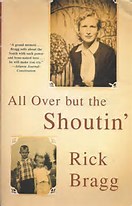 In a recent issue of Southern Living magazine, Rick Bragg published a column about a Southern character from his childhood that everyone simply knew as “The Goat Man.” This itinerant fellow traveled about the South with a herd of goats. Bragg had encountered him in Alabama in 1965. Coincidentally, I also had an encounter with The Goat Man a couple years later, perhaps in 1967 or 1968, in Georgia. The difference is that Bragg turned this incident into a salable essay, while I merely filed it away in my memory. And that’s part of what makes Bragg the excellent and prolific writer that he is. He heeds, curates and uses moments from his experiences consistently in his professional life. He sees their value as creative jumping off places for his work, and employs them when the opportunity arises. Which, in this case, I did not.
![th[8]](https://lidabushloper.com/wp-content/uploads/2016/05/th8.jpg)


![th[2]](https://lidabushloper.com/wp-content/uploads/2016/01/th2.jpg)








 Lida Bushloper