
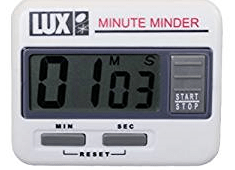
 My new best writing tool is not a new computer. It’s not a fancy word processing program. It’s not a printer, instruction book or office space. It’s a simple digital timer.
A few weeks ago I was facing a difficult writing chore. We all know that starting is the hard part, and I was dragging my feet. I wanted to use the old mental trick of saying, “just work for ten minutes.” But how to keep track? I don’t dare use the clock on my computer screen. Too easy to get distracted by the news feed, or click on that game icon. I could have used my phone, but for me, even that much tech was more a distraction than a help. My regular kitchen timer is not digital, and has that annoying “tick, tick, tick” as it’s counting down. Then I remembered a digital timer I had bought for another purpose. Turns out it was the perfect tool. Easy to set, re-set, start and stop. Silent. Big, easy to read numbers. Plus, I could put it out of my line of sight so I wouldn’t keep checking to see how much longer I had to go.
You won’t be surprised by what happened. By the time I heard the first “ding” I was well into the project. The initial reluctance had vanished, replaced by renewed interest and enthusiasm. So I set the timer for the next ten minutes. And then the next ten minutes and the next ten. When I finally slowed down, I had worked over an hour and made a sizable dent in the project. While I won’t need this trick every time, I’m glad to have it when I need it. And hey, it also works when it’s time to clean the garage!
 A few days ago, I attended an awards ceremony for a poetry competition. This was at a very small, private organization and the competition was in-house only. But from the beaming pride on the faces of the winner and two runner’s up, it might as well have been the Pulitzers. I know we’re supposed to write first of all for ourselves, but nothing, I say NOTHING, beats recognition from others, whether judges, editors, friends, or strangers, in validating what we do. It can be recognition and appreciation for our actual published work, the fact that we actually submitted something, or merely an acknowledgement of the huge effort we put in to our dream and the sacrifices we make. We would do it anyway, of course. Yes, I’ll never forget the boost I got a few months ago. I had attended at Sisters In Crime meeting and run into an old friend. He asked me about my work. After filling him in, I remarked on how much better he had made me feel. He said simply, “That’s because someone is paying attention.” It’s hard sometimes for non-writers to have any idea of what we do. So I take my figurative hugs and pats on the back where I can. I cling to them and treasure them. To all those, whether fellow writers or not, who keep providing them for me, thank you, thank you, thank you.
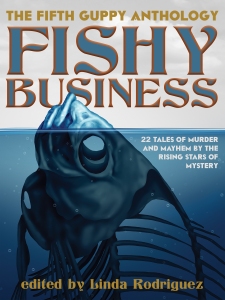
 Something Fishy will be out towards the end of the year. The
  To most people, I don’t look like a hoarder. And I’m not, in general. But when it comes to my writing, well, yes, yes I am. In trying to pare down, I’ve found that my writing related hoarding boils down to three categories. One, notebooks and scraps of paper filled with jotted ideas, random thoughts, character names, catchy phrases. Unorganized, largely unreadable, and often mystifying, therefore for the most part worthless. Why do I hang on to them? Fear. Fear that I will never have another idea. That there will come a time when my ideas run out. Hasn’t happened yet, but hey, you never know. Yet, new ideas constantly come along, and I never end up going back to the old stash. When I do (rarely), I find I can no longer recall what prompted a notation such as “torn coupon” or “strict bed rest.” So, yeah, pretty much worthless.
 This post is not about writing, reading or publishing. At least not directly. But as a writer, I’m constantly looking for ways to be more efficient, especially with my keyboard and other electronics. And so I’m recommending the book

 There are very few markets these days that still allow paper submissions, still fewer that require them. Sometimes I forget why I’m so glad about this. But yesterday I submitted a flash fiction story to a market that only accepted paper, snail-mail submissions. What a chore! First, since the story was a one-page print-out, I folded it in thirds to fit into a number 10 envelope. But, the creases kept ending up in places that made the manuscript harder to read when it was opened up. So I did the re-folding four times before I got the look I wanted. Then, the number 10 envelopes I was preparing kept getting ink smudges on the back and I had to toss several of them out. It took me a while to realize I was laying them down on a page of ink-jet printed labels that had not quite dried. Sheesh. I finally got it all together and had to make a trip to the Post Office to drop it in the slot. No way was I going to trust any other form of drop-off for something as important as a manuscript. But then I worried: Gee, that address label seemed a little loose at the corner. Would it fall off before it got to its destination? At least this, being a one page submission, only needed a regular stamp. At least I didn’t have to stand in line at the PO to have it weighed for correct postage. The whole experience was a good reminder of why I’m so grateful that these days we largely deal in electronic submissions. I guess it’s sort of like “roughing it” in the wilderness from time to time. It sure makes one appreciate the comforts of the modern world.



 Just finished reading
 I sit quietly at my desk, my mind purposely and contentedly blank. I am waiting in confidence for the next idea. This is a first for me. Normally, this office space is full of distractions. My mind jumps around. Pay that bill. Answer that invitation. Renew that library book. I’ve made attempts to deal with it by taking every single thing off the desk, putting it in a pile somewhere where I can’t see it, and only keeping the blank paper or notepad and pen in front of me. My mind wasn’t fooled by that trick. It persisted in wandering, making mental to-do lists or reliving past triumphs or humiliations. I’ve tried writing at the local library or coffee house. But, silly me, I always took along a book, “just in case.” Or I succumbed to people-watching. Or ran into somebody I know, a constant possibility in my small town.





 Lida Bushloper